Прескочи към съдържанието
In modern coating systems — especially those used for industrial, marine, and automotive applications — additives must perform under intense thermal and chemical stress. Phosphate esters, known for their multifunctionality as wetting agents, dispersants, and flame retardants, are particularly valued for their high-temperature stability and consistent performance in extreme coating environments.
Phosphate esters exhibit excellent high-temperature stability due to their strong P–O–C and P=O bonds, which resist thermal decomposition, oxidation, and hydrolysis — making them ideal additives for high-performance coatings.
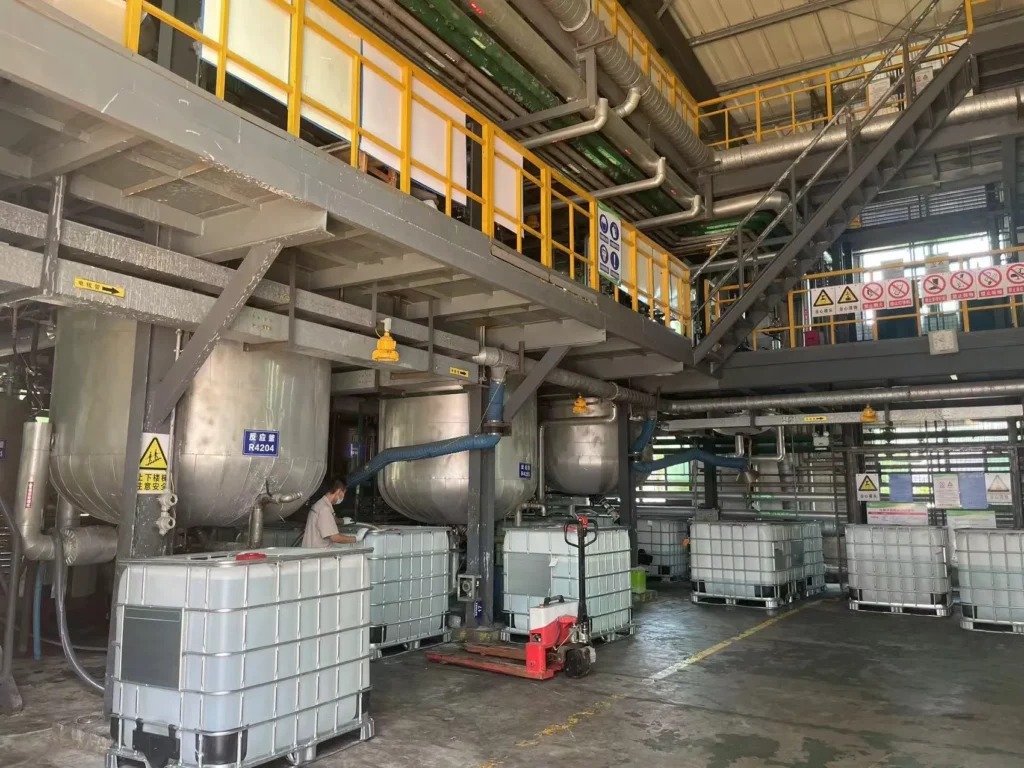
In this article, we’ll explore how phosphate esters maintain structural integrity at high temperatures, the mechanisms behind their thermal stability, and practical strategies for using them effectively in modern coating processes.
1. Why Thermal Stability Matters in Coating Formulation
High-performance coatings, such as heat-resistant paints, coil coatings, and anti-corrosion primers, are regularly exposed to:
- Elevated baking or curing temperatures (120–250°C)
- Oxidizing and acidic environments
- Prolonged UV and heat exposure
- Continuous mechanical or chemical stress
When additives degrade under heat, it leads to:
- Loss of film adhesion and gloss
- Poor pigment dispersion
- Color changes or resin yellowing
- Formation of volatile byproducts
Phosphate esters address these challenges by providing thermal and oxidative resilience, ensuring long-term coating durability and surface protection.
2. Structural Factors Behind Phosphate Ester Stability
The thermal behavior of phosphate esters depends on their molecular structure and substituents.
a. Triaryl Phosphate Esters (TPP, TCP, IPPP)
- Aromatic rings provide excellent resonance stability.
- High decomposition temperatures (≥280°C).
- Идеално за bake-cured coatings и industrial finishes.
b. Trialkyl Phosphate Esters (TEHP, TBP)
- Lower stability due to weaker C–O bonds.
- More suitable for flexible coatings and plasticized systems.
- Decomposition typically above 200°C.
c. Alkyl Aryl Phosphate Esters (BPP, IPPP blends)
- Balanced between flexibility and heat resistance.
- Widely used in polyurethane and epoxy coatings.
d. Acid Phosphate Esters
- Reactive and polar, offering strong adhesion and wetting.
- Thermal stability limited (up to ~180°C), but effective as surface-active primers.
cURL Too many subrequests.
cURL Too many subrequests. cURL Too many subrequests., cURL Too many subrequests.
cURL Too many subrequests.
cURL Too many subrequests. cURL Too many subrequests..
cURL Too many subrequests.
- cURL Too many subrequests.
- cURL Too many subrequests.
cURL Too many subrequests.
- cURL Too many subrequests.
- cURL Too many subrequests.
cURL Too many subrequests.
- cURL Too many subrequests. phosphoric acid, cURL Too many subrequests. cURL Too many subrequests..
- cURL Too many subrequests.
cURL Too many subrequests.
- Triaryl phosphate esters have low vapor pressure, ensuring minimal evaporation during curing.
Together, these mechanisms create coatings that retain gloss, adhesion, and corrosion resistance even after multiple high-temperature cycles.
4. Thermal Behavior in Different Coating Systems
| Coating Type | Typical Curing Temperature | Recommended Phosphate Ester | Функция |
|---|---|---|---|
| Epoxy Primers | 150–200°C | Acid phosphate ester + TPP | Adhesion promoter, corrosion inhibitor |
| Polyurethane Finishes | 120–180°C | IPPP / BPP blend | Огнеупорен, пластификатор |
| Powder Coatings | 180–250°C | TPP or TCP | Thermal stability, pigment dispersion |
| High-Bake Coil Coatings | 200–250°C | Triaryl phosphate ester | Heat-resistant surfactant |
| Acrylic Enamels | 140–180°C | Acid phosphate ester | Improved flow and surface tension control |
These esters ensure smooth film formation and protect polymer matrices during baking, avoiding discoloration or thermal cracking.
5. Comparative Thermal Stability of Common Phosphate Esters
| Фосфатен естер | Initial Decomposition Temp (°C) | Key Strength | Typical Application |
|---|---|---|---|
| Triphenyl Phosphate (TPP) | ~280 | High oxidative stability | Coil coatings, epoxy systems |
| Tricresyl Phosphate (TCP) | ~270 | Excellent heat resistance | Industrial enamels, lubricants |
| Isopropylphenyl Phosphate (IPPP) | ~260 | Balanced flexibility & stability | cURL Too many subrequests. |
| cURL Too many subrequests. | ~210 | cURL Too many subrequests. | cURL Too many subrequests. |
| cURL Too many subrequests. | ~180 | cURL Too many subrequests. | cURL Too many subrequests. |
cURL Too many subrequests. cURL Too many subrequests. и cURL Too many subrequests., cURL Too many subrequests.
cURL Too many subrequests.
cURL Too many subrequests. cURL Too many subrequests..
cURL Too many subrequests.
- cURL Too many subrequests.
- cURL Too many subrequests.
- cURL Too many subrequests.
cURL Too many subrequests. triaryl phosphate esters (like TPP or TCP) are incorporated:
- The film maintains clarity and gloss.
- Pigments stay evenly dispersed.
- The additive acts as a thermal buffer, absorbing excess heat energy without structural breakdown.
Резултат: Enhanced film life, reduced maintenance, and fewer coating defects.
7. Stability Enhancement Strategies for Coating Formulators
Even stable phosphate esters benefit from optimized formulation and process design.
a. Add Antioxidants
Use phenolic or aminic stabilizers to suppress oxidation at extreme temperatures.
b. Avoid Moisture Contamination
Water accelerates hydrolysis, especially for acid phosphate esters. Use moisture-tight containers and controlled environments.
c. Select Compatible Resins
Pair phosphate esters with high-Tg polymers like epoxy, acrylic, or polyimide systems for maximum stability.
d. Monitor Process Temperature
Keep curing cycles within the ester’s thermal limit (e.g., 250°C for triaryl types).
e. Use Blended Systems
Combining acid and neutral esters gives balanced adhesion and heat resistance — a common approach in marine and automotive coatings.
Dive Deeper: The Chemistry of Decomposition and Char Formation
When heated beyond 300°C, phosphate esters follow a controlled decomposition mechanism:
- P–O bond cleavage releases phosphoric acid fragments.
- These fragments catalyze char formation by dehydrating nearby polymers.
- The char layer acts as an oxygen barrier, slowing further oxidation.
This process makes phosphate esters self-protective flame retardants and key additives for coatings that require both cURL Too many subrequests..
cURL Too many subrequests.
cURL Too many subrequests.
- cURL Too many subrequests. cURL Too many subrequests.
- cURL Too many subrequests. cURL Too many subrequests.
- cURL Too many subrequests. cURL Too many subrequests.
- cURL Too many subrequests. cURL Too many subrequests.
- cURL Too many subrequests. cURL Too many subrequests.
cURL Too many subrequests. Sunzo Foundation Engineering cURL Too many subrequests.
cURL Too many subrequests.
cURL Too many subrequests.
- cURL Too many subrequests. cURL Too many subrequests.
- Reduced yellowing and oxidation in polymer matrices
- Stronger adhesion to metal and mineral substrates
- Enhanced fire resistance through phosphorus synergy
- Extended shelf life and formulation stability
These benefits explain why phosphate esters remain indispensable in automotive, aerospace, and heavy-duty industrial coatings.
Заключителни мисли
High-temperature stability is one of the defining strengths of phosphate esters.
Their robust molecular architecture allows them to endure extreme curing and service conditions — maintaining adhesion, gloss, and corrosion resistance where other additives fail.
For formulators aiming to create durable, heat-resistant coatings, partnering with a specialized supplier like Sunzo Foundation Engineering ensures access to tested, thermally stable phosphate esters and tailored formulation support for your specific system.
Свържете се с Sunzo Foundation Engineering
For high-temperature phosphate ester additives, coating formulation support, and export inquiries:
📧 Имейл: dohollchemical@gmail.com
📱 WhatsApp: +86 139 0301 4781
 Bulgarian
  English (United States)
  Russian
  German
  Turkish
  Spanish (Spain)
  Arabic
  French
  Vietnamese
  Indonesian
  Danish
  Japanese
  Bengali
  Greek
Greek  Tahitian
  Uzbek
Uzbek  English (Canada)
  Afrikaans
  Spanish (Venezuela)
  Assamese
  Tibetan
  Cebuano
  Amharic
  South Azerbaijani
  Belarusian
  Czech
Czech  Spanish (Argentina)
  Catalan
  Italian
  Moroccan Arabic
  German (Austria)
  Spanish (Chile)
  Ukrainian